
PlayCity launches monitoring system for illegal casinos. But the sites keep running

PlayCity, the agency established this spring as a special regulator of the gambling market, has launched a system for monitoring illegal websites. The new tool allows users to check the legality of any domain, report an unlicensed operator, and download a full database of blocked sites. Yet the first results of using the system highlight a gap between official claims and actual outcomes.
How the system works
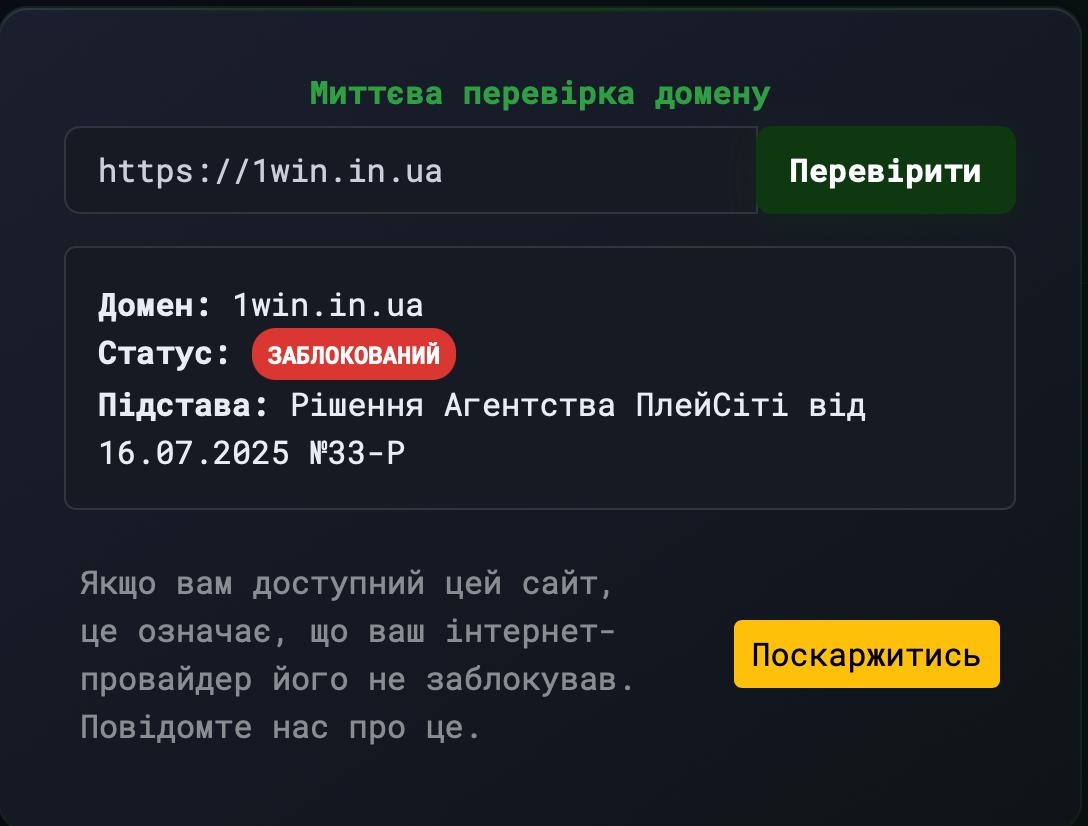
In PlayCity’s web interface, users can enter a site’s address to receive its status: “blocked” or “permitted.” If a site is deemed illegal, the system displays a red “BLOCKED” indicator along with a link to the agency’s decision, complete with number and date.
For example, the websites of Russian casinos 1win and clones of Parimatch, a brand sanctioned in Ukraine, are listed in PlayCity’s database as blocked by decisions dated July and August 2025.
What users actually see
Despite this official status, all of these sites remain accessible. A review by this publication showed that the Russian casino 1win continues to operate fully within the Ukrainian internet domain space (.ua), offering sign-up bonuses, cashback, and access to thousands of games.
This creates a clear gap between legal decisions and technical enforcement: on paper the sites are banned, but in practice access to them is unrestricted.
The Russian connection
All of the brands mentioned are of Russian origin. 1win and Parimatch form part of a Russian gambling ecosystem that actively profits from Ukrainian players. In effect, Ukrainian users are financing businesses rooted in the aggressor state.
This is occurring in the midst of a full-scale war, when sanctions and restrictions on Russian capital are supposed to be stricter than ever.
There is also a serious risk that Russian online casinos are transmitting Ukrainian users’ data to Russian intelligence services. The Security Service of Ukraine (SBU) has repeatedly recorded cases in which citizens, driven into debt through gambling, became targets for recruitment by the FSB.
Who is responsible for real blocking?
PlayCity’s website explains: “If this site is available to you, it means your internet provider has not blocked it. Please report this to us.” In other words, the agency positions itself as an arbiter, maintaining a blacklist of domains, but leaves the technical enforcement to internet providers. In practice, this means that illegal gambling sites can remain accessible for months, even after official decisions are issued.
Imitation instead of enforcement
PlayCity promotes the launch of its system as a step toward “cleaning up the market” and “eliminating the shadow segment.” In reality, however, it functions more as a showcase: creating a public database of illegal casinos; demonstrating to users that the agency is reacting to violations;
shifting responsibility for enforcement onto providers.
This approach allows PlayCity to report results without ensuring that sites are truly inaccessible.
International context
Ukraine’s model contrasts with practices in several neighboring countries. In Poland, for instance, access to the “blacklist” is directly integrated with internet providers. In France, regulators cooperate with payment systems to cut off transactions with banned operators. Ukraine, by contrast, lacks a centralized technical infrastructure that would allow enforcement to be carried out promptly.
War and the presence of Russian business in Ukraine
PlayCity has only been functioning as a regulator for a few months, and the launch of its monitoring system marks its first large-scale public initiative. Yet the rollout has already exposed structural weaknesses: the absence of an effective enforcement mechanism, reliance on providers, and the risk that the fight against illegal gambling becomes little more than formality.
Meanwhile, Russian casinos such as 1win and Parimatch continue to operate, even as Ukrainian users are shown notifications of their supposed “blocking.” This creates not only a legal problem but also a security dilemma: a country at war with Russia is simultaneously permitting Russian businesses to remain active in one of the most profitable segments of its online economy.
Is this simply a matter of technical limitations — or, more likely, an unwillingness to truly close Ukraine’s market to Russian gambling operators?

Design, style, and all the contents of website www.capital.uaare protected by copyright and law. Any use of site materials is allowed only while meeting the requirements of reprinting terms and with the reference to www.capital.ua.Only materials in public domain can be used and adding of link and/or direct hyperlink open for search engines to immediate material address on www.capital.ua. The link/hyperlink should be placed in the sub-title or in the first paragraph of the material. Font size of the link or hyperlink should not be less than the font size of the main text in the material. Any use of materials that are in closed access and are only available to registered users is allowed only with the prior written permission of the copyright owner. Reprinting, copying, reproducing, modifying or any other use of materials published with the note  of the agreement of syndication with Financial Times Limited are strictly prohibited. Use of materials which refers to France-Presse, Reuters, Interfax-Ukraine, Ukrainian News, UNIAN agencies is strictly prohibited. Materials marked
  are published as advertisements.
All rights reserved. © 2012 — 2016