
Europe Is Helping Ukraine Go Green. In the Carpathians, Its Money Has Entered an Environmental Dispute
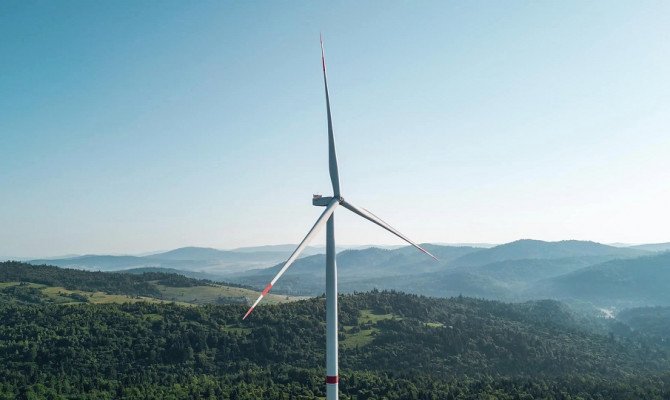
A 156-megawatt wind farm is being built on Polonyna Runa, a high-altitude mountain plateau in the Ukrainian Carpathians. The project calls for 30 turbines.
For Ukraine, whose energy system remains a prime target of Russian attacks, new generating capacity is a matter of national security. Wind power can provide decentralised sources of electricity that are harder to disable with a single strike.
But the development of Runa reveals another side of Ukraine’s green transition.
A new road has been cut through Carpathian forests to bring heavy equipment to the plateau. A corridor is being cleared for a high-voltage transmission line connecting the future wind farm to the grid. On Runa itself, construction crews are building service roads, pouring turbine foundations and installing the first turbines.
The development has already triggered court cases and criminal investigations over forest clearing, earthworks and construction carried out before the environmental assessment was completed. Law-enforcement authorities are examining, among other things, the construction of turbine foundations that began before the project received its environmental impact assessment (EIA) approval. The wind farm eventually received a positive EIA decision in February 2026, but the dispute over its environmental impact has continued.
The Runa case points to a problem that could extend far beyond a single Carpathian plateau. What is physically one energy complex has been divided among different projects, companies and environmental procedures.
There is also a European dimension. Oschadbank, one of Ukraine’s largest state-owned banks, financed equipment now being used to build the wind farm. The bank later entered an energy-lending risk-sharing programme with the European Bank for Reconstruction and Development (EBRD), backed in part by European Union guarantees. Whether the Runa-related loan itself was covered by that programme is now a central question in the dispute.
One Wind Farm, Several Projects
Building a wind farm on a mountain plateau requires much more than installing turbines. Tower sections weighing many tonnes and enormous turbine blades have to be transported to the site, requiring suitable roads. The electricity then has to reach the national grid, requiring a high-voltage transmission line.
Physically, the road, transmission line and turbines are components of the same energy development.
Legally, at Runa they have been treated separately.
The road through the forest has been handled as a separate infrastructure project. The transmission line is subject to a separate procedure. In the documentation for the wind farm itself, forest clearing for the access road is not treated as a direct part of the wind farm’s construction.
Environmental groups describe this as project fragmentation. They argue that assessing the components separately prevents regulators from properly examining the cumulative environmental impact of all the infrastructure needed for the wind farm to operate.
The developers and Ukrainian authorities can point to the fact that each component is subject to its own legally prescribed procedure. The wind farm itself received a positive EIA decision in February 2026, while environmental groups failed in court to overturn the detailed spatial plan governing development of the site.
The separation nevertheless has a practical consequence: a permitting dispute or criminal investigation involving one component does not necessarily halt work on the others.
There is a second layer of complexity — the corporate structure.
Such structures are not unusual in large energy developments. But in Runa’s case, they matter when trying to establish who is responsible for each part of the development and, ultimately, who is financing it.
Who Is Building Runa?
Behind the project is the Wind Parks of Ukraine group, linked to former Ukrainian lawmaker Maksym Yefimov and the Mkrtchyan family.
The ownership of the group’s management company runs partly through Cyprus. Seventy-five percent is held by Astrella Holdings Limited, a company registered in Nicosia, while the remaining 25 percent is held directly by Yefimov. Ukraine’s official corporate register lists Yefimov and Rafael Mkrtchyan as the company’s ultimate beneficial owners.
The Runa development itself is divided among several special-purpose project companies.
One of them, Turyanskyi Wind Park, holds land leases on the plateau and has subleased part of the site to another project company, Polonyna Runa-1.
The ownership of Polonyna Runa-1 introduces an American connection. Ninety percent of the company is owned by US WIND AND SOLAR LLC, while the remaining 10 percent belongs to Dakar, a Ukrainian venture investment fund. Ukraine’s corporate register identifies Yefimov’s daughter, Izabella Yefimova, and U.S. citizen Alex Brick as the company’s ultimate beneficial owners.
The presence of a U.S. company in the ownership structure does not by itself establish that American capital financed the project. But it adds another jurisdiction — and another set of owners — to an already complex corporate structure.
The turbines for the group’s projects are manufactured and installed by another Ukrainian company, Friendly Wind Technology.
That company provides the link between Runa’s corporate structure and its financing.
The German Crane
On October 17, 2024, Oschadbank announced that it had provided Friendly Wind Technology with a UAH 147 million loan — roughly €3.3 million at the time — to purchase a German-made Liebherr LG 1750 mobile crane.
The financing benefited from a Ukrainian government programme that subsidises interest rates on business loans, known domestically as the “5-7-9%” programme.
By July 2026, CEE Bankwatch Network, a Prague-based environmental watchdog that monitors international development banks, had documented the same Liebherr crane working on the Runa wind farm.
Two weeks after Oschadbank announced the loan, the EBRD disclosed a new energy-financing arrangement with the Ukrainian state-owned bank.
Follow the Money
On October 31, 2024, the EBRD disclosed an Energy Security Support Facility transaction with Oschadbank. The project was approved on December 4.
Under the arrangement, the EBRD can share part of the credit risk on a portfolio of newly originated Oschadbank energy loans worth up to €100 million. The EBRD instrument itself amounts to €40 million, while at least 70 percent of the portfolio is intended to finance projects meeting the bank’s Green Economy Transition criteria.
The arrangement is supported by guarantees from the EU’s Ukraine Investment Framework and France, designed to absorb part of the losses if covered loans default.
In August 2026, Bankwatch said the Friendly Wind loan used to purchase the Liebherr crane had been included in the EBRD facility.
But there is an important chronological complication.
Oschadbank announced the Friendly Wind loan on October 17, 2024 — two weeks before the EBRD project was publicly disclosed and almost two months before it was approved. Friendly Wind Technology is not named as a specific borrower in the EBRD’s publicly available project documentation.
Whether the EBRD therefore assumed risk on this particular loan requires direct confirmation from both the EBRD and Oschadbank.
That distinction matters because the EBRD classifies its arrangement with Oschadbank as financing through a financial intermediary. Under the bank’s environmental and social framework, participating financial institutions are required to apply environmental and social risk-management procedures to relevant lending.
If the Friendly Wind loan was indeed covered by the EBRD facility, the central question is therefore not simply where the money for the crane came from.
It is this: What exactly was assessed — the purchase of a crane, or the environmental risks of the wind farm where that crane was put to work?

Design, style, and all the contents of website www.capital.uaare protected by copyright and law. Any use of site materials is allowed only while meeting the requirements of reprinting terms and with the reference to www.capital.ua.Only materials in public domain can be used and adding of link and/or direct hyperlink open for search engines to immediate material address on www.capital.ua. The link/hyperlink should be placed in the sub-title or in the first paragraph of the material. Font size of the link or hyperlink should not be less than the font size of the main text in the material. Any use of materials that are in closed access and are only available to registered users is allowed only with the prior written permission of the copyright owner. Reprinting, copying, reproducing, modifying or any other use of materials published with the note  of the agreement of syndication with Financial Times Limited are strictly prohibited. Use of materials which refers to France-Presse, Reuters, Interfax-Ukraine, Ukrainian News, UNIAN agencies is strictly prohibited. Materials marked
  are published as advertisements.
All rights reserved. © 2012 — 2016